Understanding Best Ball Fantasy Football
Overview:
The premise of best ball fantasy football is straightforward, so don’t let anyone tell you it’s not. You draft a full roster of players in a snake draft and you’re done for the length of the contest. No setting lineups, no adding players, no trades, and no more thinking or strategizing after the draft. Yes, that’s right, the only work you actually do is drafting a team, nothing more. Unless you consider checking your score from time to time as work. Each week you’ll have starters and bench players like in a standard league. The computer automatically starts the players for each starting roster spot with the highest points for the week and benches the rest of the players. It sets the line-up at the end of the games so no more worrying about leaving your highest-scoring player on the bench.
TLDR: The computer calculates your best possible line-up.
Variations of Best Ball:
There are different variations of best ball, such as daily, weekly (depending on the sport), playoff tournaments, and season-long. I’ll explain a few of the more popular variations so you have a better understanding. Make sure to read the fine print regarding the details of the contest you’re interested in. I’ve rushed into a contest without knowing all the details and it put me at a huge disadvantage. If you like donating money to strangers who probably don’t need it, then feel free to rush into a contest, or send me the money directly and I’ll kick you in the pants.
Please note, the terms used in this article aren’t necessarily “industry standard” because I’m using terms to best help you understand the concepts of best ball. When you’re done reading, you’ll be able to understand the differences and feel comfortable navigating through best ball contests.
The first thing you’ll need to do is distinguish whether you are entering a tournament or a single league (sit and go). In both cases, you’ll do a live snake draft against opponents. Contests have different draft group sizes, such as 3, 6, 10, 12, etc. Don’t get caught off guard like I once was when I entered a contest for a draft size of 6 when I thought it would be 12. Boy, was I thrown for a loop. As with any league, your draft strategy changes with this size of the draft.
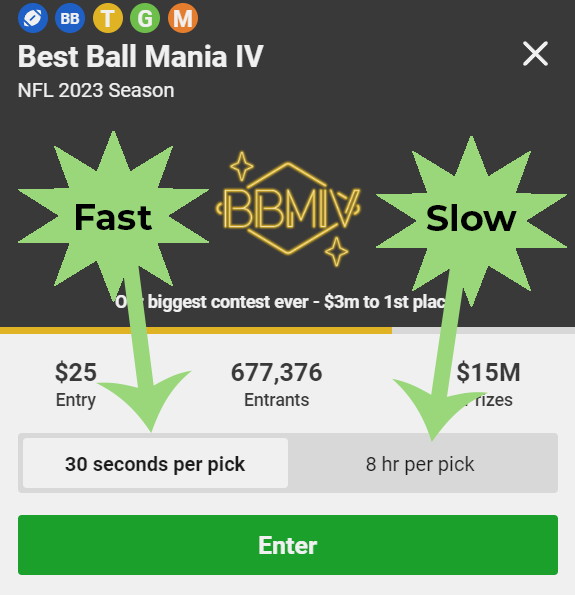
For a single league contest (sit & go) you’ll only be competing against the people you drafted with. If you enter a 6-person sit & go draft (not a tournament), you’ll play out the whole contest with only those people, no one else.
In tournaments, you’re competing against hundreds or thousands of contestants, but you only draft with a small group. You don’t pick who you draft with, the system does it. It enters you into the next draft based on the time you registered. Be ready to draft once you’ve registered, it could fill fast. On the flip side, sometimes you have to wait hours for the draft to fill.
After the draft is over, you’ll compete against your draft mates during the regular season and the winners move on to the playoffs.

I’ll explain some of the different types of contests that you’ll find on major sites such as Underdog and DraftKings. I can’t stress enough to read the details for the playoffs and payouts. These details will play a critical role in your draft strategy. As you can tell, I’ve learned my lesson after rushing into a contest not knowing all the parameters. Contestants who understand every detail have an edge.
1. Daily best ball is when you draft a roster for one day’s worth of games and it’s over. For example, you may draft an NFL line-up for Sunday, Nov. 15th, and that’s it. It’s one and done. It doesn’t continue to another round, and winners don’t advance.
2. Weekly best ball (also known as a short tournament structure) is typically for golf, where you would draft a line-up for an entire 4-day tournament. For example, you draft six golfers for the US Open and your total score for the 4-days is what counts. Your daily score doesn’t matter, it’s only your cumulative score that counts towards winning some dough. If any of your golfers don’t make the cut, tough cookies.
3. Tournament-length best ball is for the entire playoffs (aka tournament) for a particular sport such as MLB, NFL, NHL, and NBA. Participants draft only players from the actual playoff teams. Players from teams who have been eliminated from the playoffs won’t even be in the draft queue. Once a team gets knocked out of the playoffs, participants can’t score any more points from players from that team. In best ball spirit, you also can’t replace these players since no additions are allowed. All contestants compete until the end of the playoffs, regardless of how many players they still have active. Having players who make it to the finals is a huge advantage because you’ll get more games and points out of them. If you stacked your lineups with Chiefs and Eagles players last season when both went to the Super Bowl, you probably did very well. Whereas if you had several players from the Chargers and Vikings, you wouldn’t have done well because they both got knocked out in the first round.
When playing in shorter tournaments like this, you’ll draft with a set number of contestants, typically between 6 and 12. Your total score competes against all the contestants in the tournament, which is typically thousands of people. In theory, multiple participants from your draft group could win money, or possibly no one. Your total points are what matters, not where you finish in your draft group. As a matter of fact, once you draft, you don’t even see your draft group again. You’ll see your score posted on a leaderboard with all contestants.
4. Season-long best ball tournaments are the most common best ball contests that have the biggest prizes such as the milly-maker. In season-long tournaments, participants complete a draft and play out the regular fantasy season with that same group of contestants they drafted with. Generally, the first and second place of each group advance to the playoffs of the tournament. Look at it this way, there are hundreds or thousands of “leagues” playing at the same time, and all the winners and runners-up advance to compete against each other in the next round. They then either get knocked out or continue to advance to the final round until the final round of playoffs when the finalists compete for the big payouts. There are usually three rounds of playoffs. Even if you don’t make it to the final round of playoffs, you can still win some money by making it to the playoffs. Keep in mind, when you advance to the playoffs, your points go back to zero and you then play week by week. The regular season points don’t carry over into the playoffs since you compete against new people each week of the playoffs if you advance.
5. Roster variations are another form of best ball tournaments that spice things up. Sometimes sites will offer a contest that has two flex spots instead of the standard one flex, or a Superflex where a QB qualifies. If you understand the basics of fantasy sports, you’ll be fine playing these variations as long as you read the contest description. The contest title usually mentions this variation as well.
For a better understanding of the exact rules, here are links where you can find more information:
DraftKings’ Best Ball Rules
Underdog’s Best Ball Rules
Thanks for reading this article, I hope it helped! You are now ready to read our Basic Strategies for Best Ball Fantasy Football Tournaments article. Here you’ll find the strategies other people are using, what I recommend, and what seems to work well for DraftKings and Underdog.
Article written by Ryan Baker aka Primetime Playaz
Links to sign up to play DFS & Best Ball
Note, these links get me (and you) a small promo if you use them to register. Much appreciated!